
What are wisdom teeth?
Wisdom teeth — also called third molars — are the last adult teeth to develop. Most people have four: two on the top and two on the bottom.
They typically develop in the late teenage years or early twenties. In many cases, there simply isn’t enough room in the jaw for them to erupt properly.
When a wisdom tooth does not have enough space to come in normally, it is considered impacted.
Why do wisdom teeth cause problems?
Wisdom teeth sit at the very back of the mouth, making them difficult to clean properly. Even when they are not causing pain, they may still be contributing to disease.
Importantly: “No pain” does not mean “no problems.”
Research shows that pathology is often present before symptoms appear. Problems associated with impacted or malpositioned wisdom teeth include:
- Infection (pericoronitis)
- Cavities that cannot be restored
- Damage to neighboring second molars
- Periodontal disease (bone loss around adjacent teeth)
- Gum recession
- Cysts
- Tumors (rare, but documented)
- Jaw weakening
- Interference with orthodontic or restorative treatment
Studies have shown that approximately 25% of patients who believe they are asymptomatic already have inflammatory periodontal disease around their wisdom teeth (Blakey GH et al., J Oral Maxillofac Surg. 2001).
Additionally, long-term research demonstrates that the risk of future disease requiring removal exceeds 70% after 18 years of follow-up in patients who retain their third molars (Venta I et al., J Oral Maxillofac Surg. 2004).
When should wisdom teeth be removed?
Removal is generally recommended when:
- Disease is present
- There is a high risk of future problems
- The tooth is damaging adjacent structures
The goal is either to treat existing disease or prevent predictable complications.
The role of age
Timing matters.
Younger patients typically:
- Have incomplete root development
- Experience less complicated surgery
- Heal more quickly
Research shows that complication rates increase with age (Bui CH et al., 2003; Bouloux GF et al., 2007; Marciani RD, 2007).
No one can predict exactly when a wisdom tooth will cause a problem. However, when complications occur later in life, they are often more severe and more difficult to treat.
What to expect
What to expect at your consultation
Your consultation is thorough and individualized. We will review:
- Your medical history
- A clinical examination
- Panoramic or 3D cone beam imaging
- The position of your wisdom teeth
- Risks and benefits of removal versus monitoring
- Anesthesia options
- Cost and insurance questions
Every patient is different. There is no one-size-fits-all plan.
Questions are always welcome.
What to expect on surgery day
Wisdom tooth surgery is typically performed in our office under IV sedation, so you are asleep, safe, and comfortable.
The procedure usually takes about 1 to 1.5 hours from start to finish, depending on the number and position of the teeth.
What is recovery like?
Recovery is generally straightforward.
- Light bleeding is normal during the first 24 hours.
- Rest, ice, and proper pain control are essential during the first few days.
- A soft diet is recommended for about one week.
- We provide a medicated mouth rinse to keep the area clean.
Most patients begin feeling significantly better within 5–7 days.
What is Exparel?
Exparel is a long-acting form of liposomal bupivacaine (slow-release local anesthesia) that we use during surgery to help reduce postoperative discomfort and minimize narcotic use.
The goal is to keep you comfortably numb around the surgical sites for up to 24 hours after the procedure.
When can wisdom teeth be safely monitored?
Wisdom teeth may not require removal if they are:
- Fully erupted
- Functional
- Free of cavities
- Free of periodontal disease
- Positioned so they can be cleaned effectively
- Not causing damage to neighboring teeth
In these cases, active surveillance is appropriate. This means periodic exams and imaging to ensure no disease develops over time.
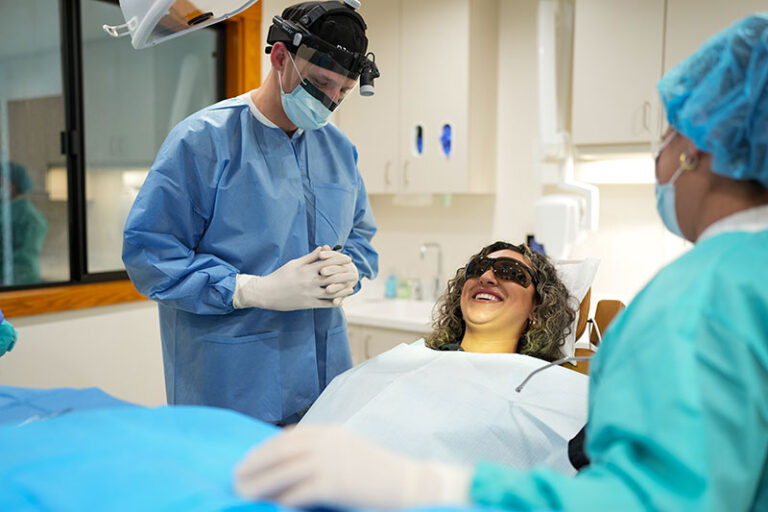
Risks of wisdom tooth removal
Most patients recover without complication.
However, as with any surgical procedure, risks exist.
Possible risks include:
- Swelling and discomfort
- Bleeding
- Infection
- Dry socket
- Temporary (and rarely permanent) numbness of the lip, chin, or tongue
- Delayed healing
We review all risks and benefits thoroughly before proceeding.
Why evidence-based management matters
Wisdom tooth management should be deliberate and individualized.
Evidence-based care means:
- Integrating the best available scientific research
- Applying clinical expertise
- Considering patient values and preferences
There is no automatic answer for everyone.
Some wisdom teeth should be removed.
Some should be monitored.
The key is thoughtful evaluation and ongoing follow-up.
- Our philosophy
No one can predict exactly when a wisdom tooth will cause a problem. However, when complications occur later in life, they are often more severe and more difficult to treat.
Frequently asked questions
Answers to the questions we hear most from patients.
Do all wisdom teeth need to be removed?
No.
Removal is recommended when disease is present or highly likely to develop. Some wisdom teeth can be safely monitored if they are healthy and functional.
If they don’t hurt, why remove them?
Pain is often a late sign of disease. Many “asymptomatic” wisdom teeth already have underlying periodontal inflammation.
Waiting until pain develops may mean the condition has progressed.
Is it better to remove wisdom teeth at a younger age?
In many cases, yes.
Surgery is often technically easier in younger patients, healing is faster, and complication rates are lower compared to older adults.
What happens if I keep my wisdom teeth?
Retention requires active monitoring.
Long-term studies show that retained wisdom teeth are associated with increased risk of disease, including damage to adjacent second molars.
How do you decide what’s best for me?
We evaluate:
- Your clinical exam
- Your imaging
- Tooth position
- Your age
- Your medical history
- Your personal risk tolerance
Then we discuss everything together and determine the best plan for you.