Why is anesthesia used?
Many oral surgery procedures can cause anxiety or discomfort. Anesthesia allows us to perform treatment safely and comfortably while minimizing stress.
Our goal is simple:
- Keep you comfortable
- Keep you safe
- Tailor the experience to your individual needs
Some patients do very well with local anesthesia alone. Others prefer deeper sedation. There is no single “right” option — it depends on your health, your procedure, and your comfort level.
What are the anesthesia options?
Local anesthesia
Local anesthesia numbs the surgical area while you remain fully awake.
- You will feel pressure, but not pain.
- You can drive yourself home.
- Recovery is immediate.
This is appropriate for smaller procedures and patients who are comfortable with treatment while awake.
Nitrous oxide (laughing gas)
Nitrous oxide is inhaled through a small nasal mask.
- Helps reduce anxiety
- Works quickly
- Wears off quickly
- You remain awake and responsive
Nitrous can be used alone or combined with local anesthesia.
Oral premedication (Triazolam)
Oral sedation involves taking a prescribed medication (commonly triazolam) before your appointment.
- Produces relaxation and drowsiness
- You remain responsive
- Memory of the procedure is sometimes limited
Because it affects alertness, you will need an escort to drive you home.
Combination therapy
IV sedation / general anesthesia
IV sedation is commonly used for wisdom teeth, multiple extractions, implants, and more involved procedures.
Medication is administered through an IV line. You are:
- Deeply relaxed
- Typically unaware of the procedure
- Closely monitored throughout
Many patients describe it as “falling asleep and waking up when it’s over.”
In some cases, deeper general anesthesia may be appropriate.
Safety and evaluation
Not everyone is automatically a candidate for every level of anesthesia.
Before recommending sedation, we perform a thorough evaluation including:
- Medical history review
- Medication review
- Airway assessment
- Discussion of prior anesthesia experiences
- Vital signs evaluation
Certain medical conditions may require additional precautions or treatment in a different setting.

Advanced facility options
For patients who require additional medical support or prefer hospital-level care, we have options to perform procedures at:
- An outpatient surgery center
- The operating room at Community Hospital of the Monterey Peninsula
- With a board-certified anesthesiologist if indicated
Your safety always comes first.
What are the risks of anesthesia?
All forms of anesthesia carry some level of risk, although serious complications are rare.
Possible risks include:
- Nausea or vomiting
- Allergic reactions
- Breathing changes
- Blood pressure fluctuations
- Heart rhythm changes
- Very rarely, serious medical events
The good news is that outpatient anesthesia administered by oral and maxillofacial surgeons has been shown to be extremely safe.
A large study reviewing 17,634 outpatient sedations performed by oral and maxillofacial surgeons between 2004 and 2019 demonstrated a very low rate of adverse events, supporting the safety of office-based anesthesia when performed by properly trained specialists.
Wiemer G, et al. Safety of Outpatient Procedural Sedation Administered by Oral and Maxillofacial Surgeons: The Mayo Clinic Experience in 17,634 Sedations (2004 to 2019). Journal of Oral and Maxillofacial Surgery. 2021.
Oral and maxillofacial surgeons receive extensive hospital-based anesthesia training during residency and are uniquely qualified to provide office-based sedation.
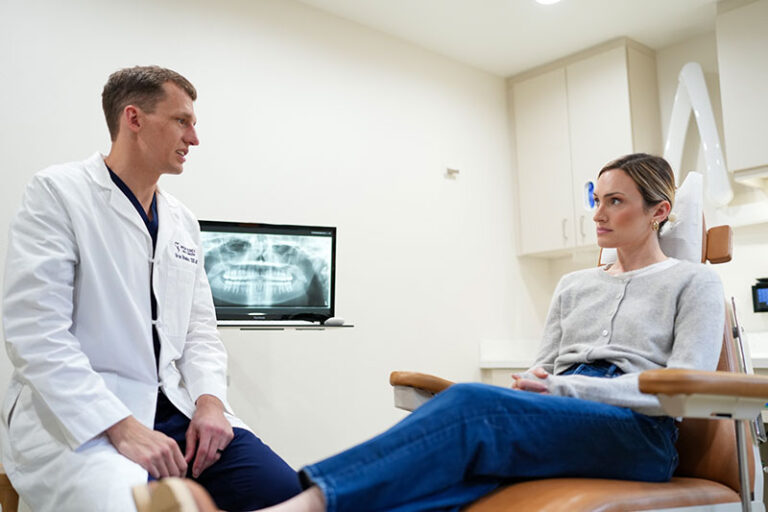
What to expect on the day of surgery
If you are receiving sedation or IV anesthesia:
- Do not eat or drink for the instructed period before surgery
- Take only approved medications
- Wear loose, comfortable clothing
- Remove contact lenses and jewelry
You must have a responsible adult escort:
- To drive you home
- To stay with you for the first several hours
You may feel groggy for the remainder of the day. Most patients return to normal activities the following day, depending on the procedure.
- Our philosophy
Anesthesia is not one-size-fits-all. Some patients prefer to be fully awake. Others prefer to be completely asleep. We take the time to understand your health history, your comfort level, and your procedure — then recommend the safest and most appropriate option.