
What are PRP and PRF?
Both PRP (Platelet-Rich Plasma) and PRF (Platelet-Rich Fibrin) are derived from your own blood. They are used as biologic enhancements to help promote tissue healing, reduce inflammation, and support bone and soft tissue regeneration.
Here’s how they differ:
PRP is a concentrated plasma with a high number of platelets and growth factors, designed to kick-start healing immediately after placement.
PRF is a more advanced form — it is spun at a lower speed during preparation, leaving a fibrin matrix that contains platelets, white blood cells, and growth factors. The fibrin network gradually releases these factors over time, supporting extended healing and regeneration.
Because both are “autologous” (from your own body), there is virtually no risk of allergic reaction, and they work with your natural healing processes.
Why are they used in bone grafting?
When we perform bone grafting (such as socket preservation, ridge augmentation, or sinus lift), our goal is not just to fill space with material — it’s to help your body regenerate healthy new bone.
PRP and PRF help in several ways:
Growth factor delivery
Enhanced healing
Reduced bone loss
Better vascularization
By concentrating growth factors at the surgical site, PRP and PRF can improve blood vessel formation, which is crucial for new bone to survive and integrate with graft materials.
Rather than acting as “magic,” these biologics help tip the body’s natural healing environment in favor of regeneration — an especially useful support when grafting bone or soft tissue in the oral and maxillofacial area.
How are they prepared?
- Blood draw: A small amount of your blood is drawn, similar to a routine lab test.
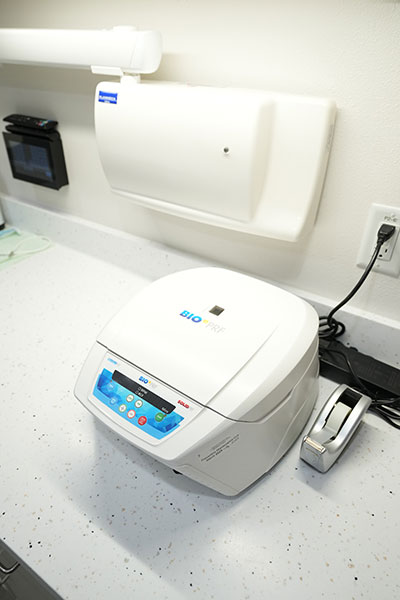
- Centrifugation: The blood is spun in a centrifuge to separate components.
- Application: The resulting PRP or PRF is placed at the surgical site — either mixed with bone grafting material, as a clot/membrane, or injected into joint spaces such as the TMJ.
This process usually takes 10–20 minutes and is done in the office or surgical suite.
Advantages of PRP/PRF
- Autologous and safe — uses your own blood.
- No risk of rejection or disease transmission.
- Can enhance early bone and soft tissue healing.
- PRF provides a sustained release of growth factors to support longer-term regeneration.
- Can improve the quality of grafted bone and soft tissue integration.
It is important to understand that while PRP and PRF are helpful adjuncts, they do not replace good surgical technique, proper graft selection, or patient-specific planning — they enhance healing within that framework.
Use of PRP/PRF in the TMJ
In addition to bone grafting, PRP and PRF have been explored for intra-articular therapy in the TMJ — particularly in degenerative joint disorders and TMD. Recent studies suggest that injectable PRF (I-PRF) may reduce TMJ pain and improve jaw function by modulating inflammation and promoting soft tissue health.
While evidence continues to grow, early clinical research supports the idea that PRP and PRF injections — often used alongside standard treatments — can be a promising therapeutic option for selected patients with TMJ degeneration or dysfunction.
Important things to know
- PRP and PRF are not standalone “cures.” They are biologic adjuncts that support your body’s healing.
- Not all clinical situations need PRP or PRF — our clinical evaluation determines when they add meaningful benefit.
- Our philosophy
Because they are derived from your blood, the safety profile is excellent.