
Why would someone need bone grafting?
Bone grafting is performed when there is not enough natural bone to safely support a dental implant or maintain the natural contour of the jaw.
Bone can be lost due to:
- Tooth extraction
- Long-standing missing teeth
- Periodontal (gum) disease
- Infection
- Trauma
- Cysts or tumors
After a tooth is removed, the surrounding bone begins shrinking almost immediately. In fact, studies show that up to 40–60% of ridge width can be lost within the first six months after extraction.
Because of this predictable bone loss, we often recommend grafting either at the time of extraction or before implant placement to rebuild or preserve bone for long-term stability.
- Nemcovsky & Serfaty (1996)
Nemcovsky CE, Serfaty V. Alveolar ridge preservation following extraction of maxillary anterior teeth: Report on 23 consecutive cases. Journal of Periodontology. 1996 Apr;67(4):390–395. doi:10.1902/jop.1996.67.4.390. PMID: 8708965. - Lekovic et al. (1997)
Lekovic V, Kenney EB, Weinlaender M, Han T, Klokkevold P, Nedic M, Orsini M. A bone regenerative approach to alveolar ridge maintenance following tooth extraction: Report of 10 cases. Journal of Periodontology. 1997 Jun;68(6):563–570. doi:10.1902/jop.1997.68.6.563.
What is socket preservation?
Socket preservation is a bone graft placed immediately after a tooth extraction to help maintain the width and height of the jawbone.
When no grafting is performed, significant collapse of the bone occurs — especially in the first three months. This can make future implant placement more difficult and sometimes requires additional surgery later.
What This Means for You
When we perform socket preservation:
- Graft material is placed into the extraction site
- A protective membrane is often placed over the graft
- The area heals over approximately 3–4 months
While grafting does not completely eliminate all bone change, it significantly reduces the amount of collapse compared to extraction alone.
How long does bone grafting take to heal?
Healing time depends on the size and location of the graft
- Socket preservation: ~3–4 months
- Moderate ridge augmentation: ~4–6 months
- Sinus lift or larger grafts: ~6–9 months
Bone graft material acts as a scaffold. Over time, your body replaces it with your own living bone.
We confirm healing with clinical exams and imaging before placing implants.
What is a sinus lift?
A sinus lift (sinus augmentation) is a bone graft performed in the upper back jaw.
In this area, the sinus cavity sits just above the roots of the molars. After tooth loss, the sinus can expand downward and the bone becomes too thin for implants.
A sinus lift involves:
- Gently elevating the sinus membrane
- Placing bone graft material beneath it
- Allowing the area to heal and form new bone
- Healing typically takes 6–9 months, depending on the case.
This procedure allows safe and predictable implant placement in areas that would otherwise lack sufficient bone.
Types of bone grafting materials
Xenograft (typically bovine bone)
This is the most commonly used graft material. It is derived from purified bovine (cow) bone and acts as a scaffold for your body to regenerate new bone.
Advantages:
- Highly predictable
- No second surgical site
- Excellent space maintenance
Autogenous bone (your own bone)
Often considered the gold standard because it contains living bone cells and natural growth factors.
Common donor sites include:
- The jaw (chin or posterior mandible)
- The iliac crest (hip) for larger reconstructions
Advantages:
- Excellent regenerative potential
- Faster integration
The tradeoff is the need for a second surgical site in certain cases.
Allograft (donor human bone)
Processed and sterilized bone from a tissue bank. Well studied and commonly used.
In many cases, we combine graft types to optimize healing and stability.
What is bone morphogenetic protein (BMP)?
Bone Morphogenetic Protein (BMP) is a naturally occurring protein that stimulates bone formation.
Recombinant BMP can be used in select cases to encourage your body to generate new bone without harvesting bone from another site.
It is typically reserved for larger or more complex grafting procedures.
What is GEM 21?
GEM 21 is a regenerative grafting material
GEM 21 combines:
- A synthetic bone scaffold
- Recombinant human platelet-derived growth factor (rhPDGF)
This growth factor stimulates bone formation, blood vessel development, and soft tissue healing. It is commonly used in periodontal and ridge augmentation procedures.
What is a membrane?
A membrane is a protective barrier placed over a bone graft.
It serves to:
- Stabilize the graft
- Prevent soft tissue from collapsing into the space
- Allow bone cells time to regenerate
Membranes may be resorbable (dissolve on their own) or non-resorbable (removed later).
They are a key component of guided bone regeneration.
How we use the latest advances in bone grafting
Modern bone grafting has evolved significantly.
We utilize:
- 3D imaging for precise planning
- Safe and proven graft products
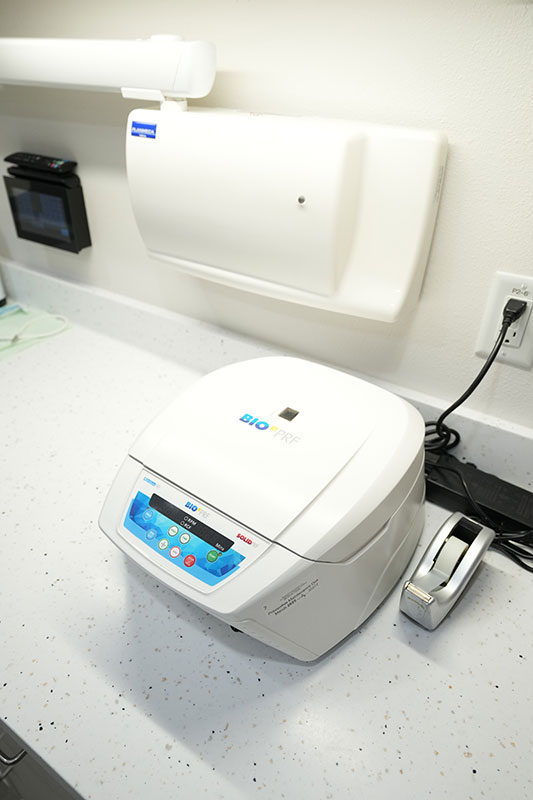
- Growth factor–enhanced regenerative products
- Advanced membrane technology
- Our philosophy
Our goal is predictable, stable bone that supports long-term implant success and maintains facial structure.